Categories
Updates

Our Falcons Are 3 Weeks Old!

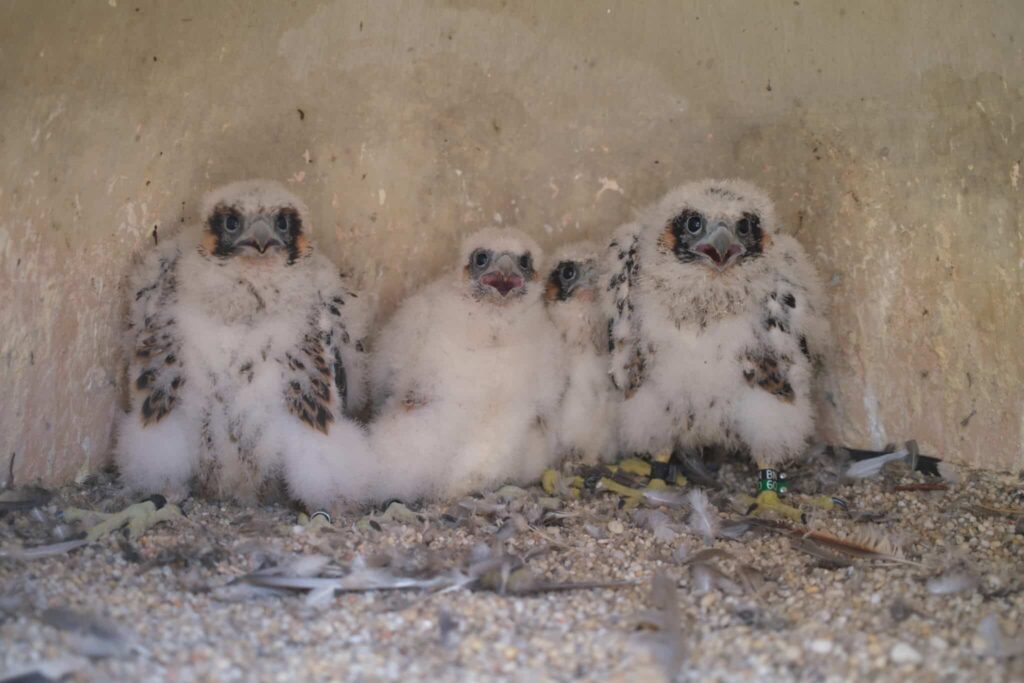
The eyases (young falcons) are now three weeks old and their flight feathers have emerged from pin. At this age they are looking (and exploring) beyond their nest. Their eyesight has improved dramatically as they watch their parents fly above their nest and planes in the sky. They are venturing outside of their nest, as it gets more cramped and warm, especially on sunny days.

Thankfully, we have observed no signs of trichomoniasis and this is the first year in a long time (maybe forever?) that they were not treated preventative medicine. There has also been no signs of infestations of a wingless parasitic fly on the eyases that has affected coastal falcon nests. The wingless flies feed on blood in their underwing area. It is evident when we see a lot of dirt (fecal matter) and feather loss in that area of their bodies. Another really good sign that these young are all in good health. Even the little guy isn’t looking so little anymore.

Hamming it up!

Banding is still scheduled for the morning on Monday, May 19. We’ll be sure to update everyone on social media about the banding event that day.

Categories
Updates

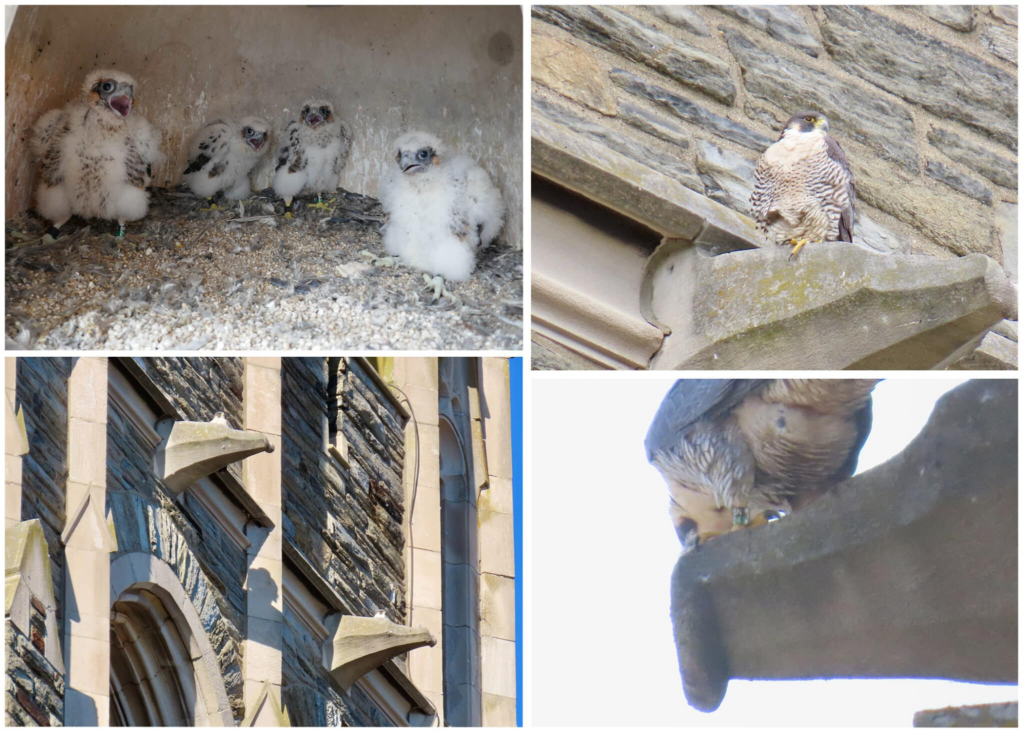
That looks like the leg of a female falcon!

The youngest peregrine falcon nestling, who hatched on April 28, is now one week old, while its three older siblings are approaching two weeks. With each passing day, these young falcons—called eyases—are growing stronger and more alert under the watchful care of Frida and Mango.


At this stage, they are still covered in fluffy white down and rely entirely on their parents for warmth and food. They are often observed sleeping but also preening their downy feathers. Their eyesight is improving and they are starting to look around as they explore their nestbox. Feeding time is frequent, with the adults carefully tearing food into small, manageable pieces of prey. We’ve seen them bring in a variety of prey, mostly songbirds, including mourning doves, blue jays and homing pigeons. The larger the young get, the more prey they need, as they tend to eat around half their body weight each day.


Looking ahead, biologists are planning to visit the nest on May 19 to carefully band the eyases. Each band placed on a peregrine falcon chick has a unique combination of letters and numbers, kind of like a falcon’s license plate! These bands allow biologists to identify individual birds years later—sometimes from hundreds or even thousands of miles away—just by spotting them and reading the code on their band.

Categories
Updates

Fourth hatching!

On the morning of April 28th viewers noted the presence of a fourth hatching! This is right on schedule for when it was laid, which was five days later than egg #3 and same time period after other eggs hatched. What a happy surprise, as I’m sure most of us were thinking that if the fourth didn’t hatch soon then it wouldn’t. We’ve seen how quick parental care shifts from incubation to brooding and feeding young. In a few days the oldest nestlings will be a week old. The adults will continue to brood them as they are not quite able to regulate their body temperatures. During the day, the adults will start to leave them unattended for short periods when temperatures are at their warmest. We are keeping an eye on them for signs of trichomoniasis, which is a pigeon borne disease that can be fatal to young PEFA if not treated.

Categories
Updates

Incubation continues with a little housekeeping

Incubation continues with a little housekeeping.  As of April 9, we are at day 20 of incubation, which began after the third egg was laid. The fourth was laid five days later. Falcons typically incubate for around 30 days, so we should start to see signs of hatching late next week. Once eggs begin to hatch, attention of adults will be directed towards their young with less going to the fourth egg. We shall see if it does hatch.

Categories
Updates

One of our 2023 fledglings has taken up residence in Philadelphia

Top left photo by Kathy Clark and others by Karl Platzer.

This week Kathy Clark, Chief/NJDEP Fish & Wildlife/ENSP received a report of BN/24, a female that was banded at the Union County Courthouse in 2023. She is now frequenting a tall building at Saint Joseph’s University in Philadelphia. She has been observed with a banded male falcon (BH/40), that fledged from a nest atop the NJ side of the Walt Whitman Bridge in 2022.

Students and staff have noted the presence of the falcons since fall 2024 and even wrote about them in the school paper. They have been seen perching, feeding and mating on Barbelin Hall. It looks like the site could be a great location for them to nest. Add an igloo atop the roof, add some gravel and you have a new falcon nest site.

Karl Platzer reports that BN/24 has been observed daily since Fall 2024, usually perched on the Barbelin Hall bell tower at Saint Joseph’s University Philadelphia campus (AKA Hawk Hill).

In other news, the pair continues to incubate the four eggs. In another two weeks we will be watching for hatching.

Categories
Updates

Mango gets his chance to incubation four eggs

How can you not love getting surprised by a fourth egg! I had a feeling that by saying “it appears that no more eggs will be laid” another would be laid.  Peregrines typically lay 4 and sometimes 5 eggs. The fourth was laid at 2:26:02 PM on March 25. It just took Frida a little more time to develop her last egg (will there be one more?). With that said, incubation is still in full swing.

Categories
Updates

Egg Update

It appears that no more eggs will be laid this spring, as the forth egg would have been laid over the weekend. This is not abnormal, as their average clutch size varies from 3-4 (sometimes 5). With incubation underway, this puts hatching to begin towards the tail end of the second full week in April.

Over the next several weeks, we will watch as the pair incubate the eggs where the female does the majority of incubation duties. She will occasionally get breaks to stretch, feed and preen where the male takes over. They will shift/roll eggs to ensure they develop properly several times a day. This prevents the developing embryo from sticking to the shell and ensures even heat distribution.

Categories
Updates

Frida and Mango are now incubating three eggs

Happy Spring! Frida and Mango are now incubating three eggs! The second was laid on March 17 and the third was laid early this morning. Now that they have almost a full clutch of eggs, they will be incubating them more. Their typical incubation period lasts 28 days and the last egg should be laid late tomorrow or early Saturday. This puts hatching close to the beginning of Earth Week. Delaying incubation is a natural adaption where all eggs hatch very close to each other and gives all young a better chance of surviving, where with ospreys, they start incubating after the first egg is laid and there are usually more differences in ages of young. This accounts for shortages in prey where only the oldest may survive if there is not enough food.

Categories
Updates

First Egg of 2025

On the morning of March 15 at 6:30am, viewers got their first glance of the first egg. We knew egg laying was close as the pair has been observed copulating, performing eee-chup courtship (bowing) displays on camera. Frida has also been spending more time in the nest box preparing her scrape, which is a shallow depression in the nest box where eggs are laid. Peregrines do not build a nest like hawks, eagles and ospreys and instead create a shallow depression in gravel, soil and other debris to nest. This is often the case on ledges of cliffs and in our human dominated landscape, it also includes tall buildings and sometimes flowerpots left unattended on upper floors of apartment building patios. The second egg should be laid sometime over night or tomorrow.

On another note, we decided to wait to remove the worn green carpet for perching. Introducing disturbance to the pair before laying began would not have been good. Instead, we will swap this carpet when we visit the nest for a health check after the young hatch in around 45 days (late April).

Lastly, we opened up chat on two of the live streams on our YouTube channel, so you can watch and talk with other viewers. BW

Categories
Updates

2025 Update

Frida, the female peregrine falcon, sits in the nest box that is located on the top of the Union County Courthouse in Elizabeth.

Here we go! Those watching closely have seen the pair more and more lately as they strengthen their pair bond by mating and bowing to each other in the nest box. Some light maintenance will occur sometime in the next two weeks. The green carpet that is worn will be replaced, prey remains will be cleaned up, and lens covers will be cleaned.

Some seasonal notes. Last year the first egg was laid on March 16. In 2022 + 2023 it was March 19, so who wants to bet that an egg will be laid during the third week of March? I’m betting it will be earlier than last year. Time will tell. Either way, it will be great to focus on wildlife and see some new life after what seemed like a really cold, long and dark winter.