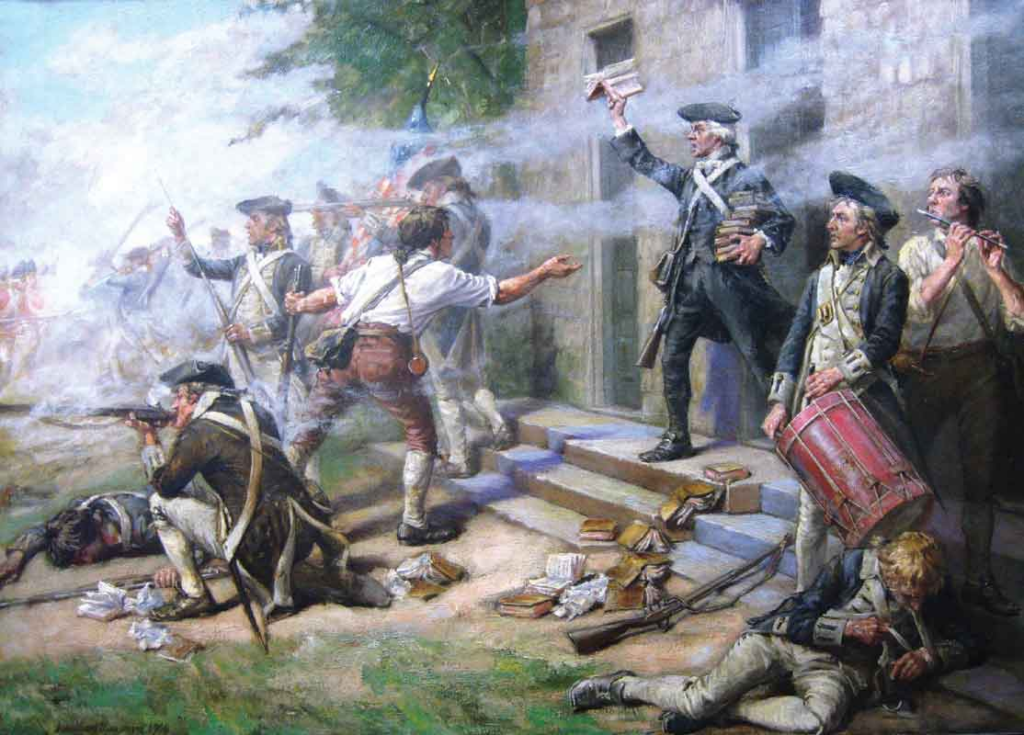
Two weeks later, on June 23, the 6,000 British troops again crossed the water, marched through the ruins of Connecticut Farms, and faced the 1,500 Americans waiting on the Springfield side of the Rahway River. Confrontations occurred along the Rahway, from the bridge at Morris Avenue to Vauxhall. During several hours of intense fighting, the British and Hessians pushed into the village of Springfield, and north into the center of Millburn, before being forced to retreat.
During the battle, the Americans were running out of wadding to load their muskets. Gunpowder and a lead ball would be wrapped in paper and then rammed down the barrel, with paper wadding holding everything tightly in place. On hearing the need for paper, the Rev. James Caldwell rode to his church, grabbed a stack of hymnals written by Isaac Watts, and took the books to the soldiers to use the pages for wadding. As he did, he shouted, “Give ’em Watts, Boys!,” a battle cry that “went viral,” as it might be described today..
As the British retreated, they again burned buildings in the village, including the church. One house (now the Cannon Ball House), struck by an American cannonball, was among the few left standing. The little-known Battle of Springfield turned out to be the final major confrontation between the American and Crown forces in the North. It would be the Last Invasion in the northern colonies, one that left an indelible impression on the British General Henry Clinton..
The mauling he Crown Forces took at Connecticut Farms and Springfield that June was well remembered by Clinton, who opted not to attack Washington’s and Rochambeau’s forces as they marched unchallenged through New Jersey the following year on their way to Yorktown, for what would be final showdown of the American Revolution.